Tarbiya
Spiritual training under a qualified guide — the method by which the seeker is brought from formal worship to direct experiential knowledge of God.

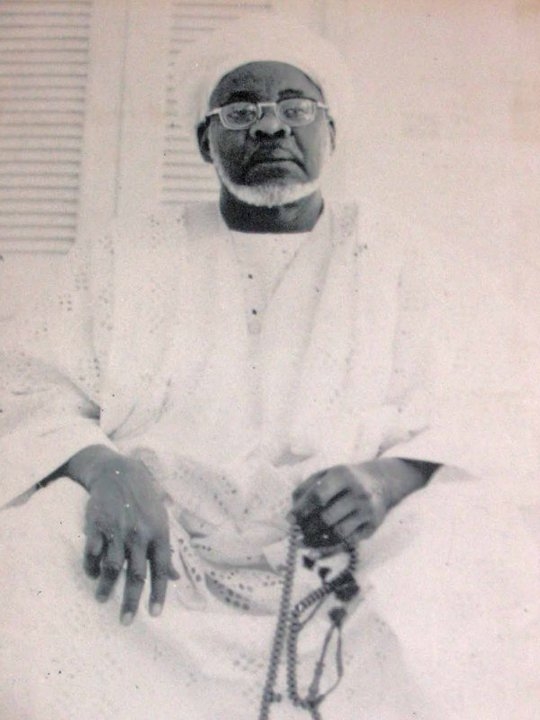
1900 — 1975 · Shaykh al-Islām · Medina Baye, Senegal
“The Fayḍa is a flood. It will reach every door, and no one will be turned away who knocks with a sincere heart.”
The Man
Born at the dawn of the twentieth century in colonial Senegal, Shaykh Ibrāhīm ibn ʿAbd Allāh Niasse — known affectionately as Baye, “our father” — became one of the most influential Muslim figures of his era.
He inherited the Tijāniyya from his father, but at twenty-nine he announced something more: that he was the bearer of the long-awaited Fayḍa, the spiritual flood promised by Shaykh Aḥmad al-Tijānī more than a century earlier. Through it, the direct knowledge of God — once thought to belong only to a chosen few — would become available to the many.
From a modest settlement outside Kaolack, his message crossed deserts, languages, and empires. Kings, scholars, traders, and labourers alike took his hand. By the time of his death in 1975, the Niassene branch of the Tijāniyya had become one of the largest Sufi movements in the world.
On the Fayḍa
“Whoever wants to know Allah — let him come. The door is open, and the cup is full.”
— Shaykh Ibrāhīm Niasse, Kāshif al-Ilbās

What is the Fayḍa?
The word fayḍa means an overflowing, a flood, a downpour. In Tijānī tradition it refers to a promised era in which the spiritual realities of the path — long kept within tight circles of initiates — would pour out upon ordinary people.
Shaykh Aḥmad al-Tijānī (d. 1815) had foretold that this flood would come through one of his followers, after a long period of waiting. In 1929, Shaykh Ibrāhīm Niasse declared in clear terms that he was its bearer. What followed was unprecedented: ordinary disciples — farmers, mothers, students — were guided into the direct experience of maʿrifa, the knowledge of God.
His method, tarbiya, became the heart of the movement: a patient spiritual upbringing under a qualified guide, returning the seeker to the Quranic command, “Know that there is no god but Allah.”
A Life
From a quiet birth in Taïba Niassène to the moment millions across three continents called him their guide — the key moments in the life of Baye.
Abū al-Faiḍ Ibrāhīm ibn ʿAbd Allāh Niasse is born to the eminent scholar Al-Ḥājj ʿAbd Allāh Niasse, a leading muqaddam of the Tijāniyya order. From childhood he is immersed in the Qurʾān, ḥadīth, and the litanies of the path.
He memorises the Qurʾān before the age of ten and progresses rapidly through the classical sciences — Arabic grammar, fiqh, tafsīr, and taṣawwuf — under his father and the scholars of his region.
Following the passing of Al-Ḥājj ʿAbd Allāh, the young Ibrāhīm continues teaching and guiding seekers, gaining a reputation for his eloquence, depth, and luminous spiritual states.
At only twenty-nine, he declares himself the bearer of the Fayḍa Tijāniyya — the spiritual flood foretold by Shaykh Aḥmad al-Tijānī — through which knowledge of God (maʿrifa) would become accessible to multitudes, men and women alike.
He establishes Medina Baye on the outskirts of Kaolack as a centre of teaching, tarbiya, and spiritual training. It becomes a magnet for seekers from across West Africa and beyond.
After a celebrated pilgrimage and visits to Fez, the Emir of Kano, Abdullāhi Bayero, takes Shaykh Ibrāhīm as his spiritual guide. The Fayḍa spreads rapidly into Nigeria, Mauritania, Ghana, Niger, Mali, and beyond.
He addresses the World Islamic Conference at Al-Azhar and is publicly honoured with the title Shaykh al-Islām — a recognition by the foremost scholars of his stature as a renewer of his age.
Shaykh Ibrāhīm Niasse passes away in London on the 26th of Rajab, 1395 AH (July 1975), and is buried in the great mosque of Medina Baye, where millions continue to gather each year for the Mawlid.
What he taught
Spiritual training under a qualified guide — the method by which the seeker is brought from formal worship to direct experiential knowledge of God.
Gnosis, the heart of the Fayḍa. Shaykh Ibrāhīm insisted maʿrifa was not the preserve of an elite, but a station open to every sincere seeker of the path.
He taught that race, language, and class dissolve before the door of Allah — uniting Africans, Arabs, Europeans, and Asians under a single spiritual family.
He championed the full religious education of women, naming several as muqaddamāt with authority to teach and initiate — radical for his time and place.

Legacy
Fifty years after his passing, the community he raised continues to grow on every continent.
Among his celebrated works are Kāshif al-Ilbās on Sufi metaphysics, Fī Riyāḍ al-Tafsīr, a six-volume commentary on the Qurʾān, and countless dīwāns of devotional poetry still sung across West Africa today.